Maximum Height Calculator – Projectile Motion
Maximum height in projectile motion
Use this maximum height calculator to figure out what is the maximum vertical position of an object in projectile motion.

Introduction / Overview
The Maximum Height Calculator is a tool for finding the highest vertical position a launched object reaches during projectile motion. Whether you throw a ball, kick a soccer shot, or run a classroom experiment, it helps you answer one simple question: “How high will it go?”
What problems does it solve?
It quickly links your inputs (launch speed, angle, and initial height) to peak height. It can also work in reverse: if you know the peak height, it can help you back-calculate other values.
Who is this for?
Students checking homework, athletes and coaches sanity-checking a throw, makers building launchers, and anyone who wants a fast, unit-safe answer.
The calculator uses standard constant-acceleration physics with gravity. It assumes no air resistance and a constant gravitational acceleration.
How to find the maximum height of a projectile?
A projectile rises until gravity slows the vertical motion to a stop. At the very top of the trajectory, the vertical velocity is:.
The 3 key ideas (no heavy math):
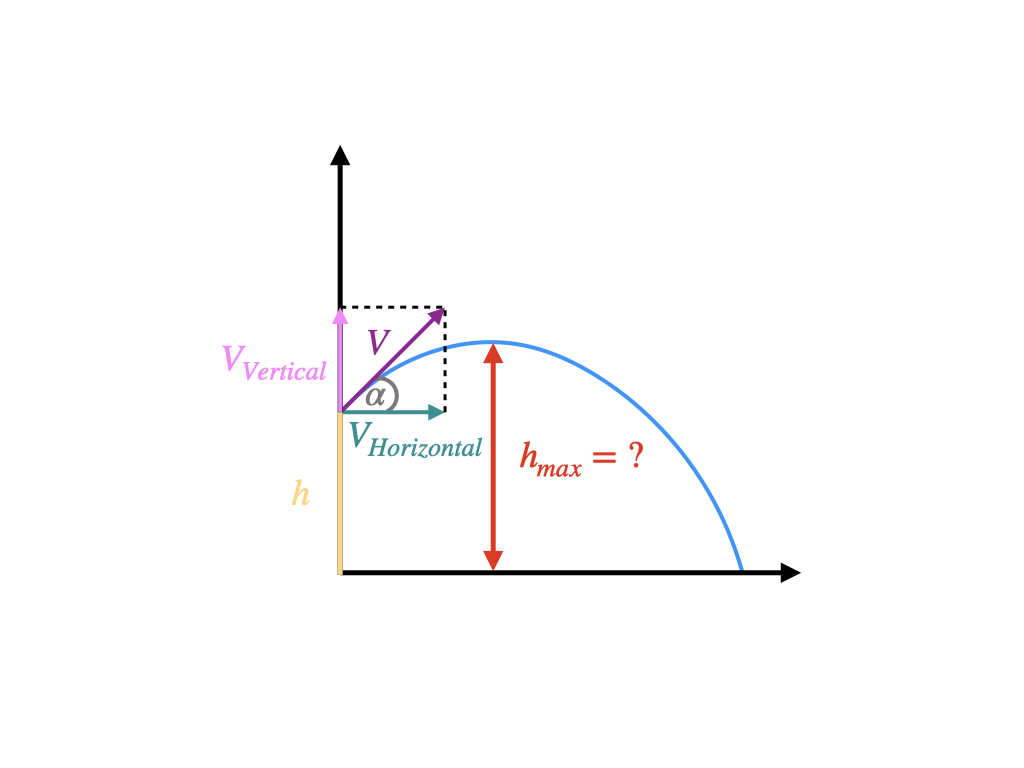
- Split the launch speed into components:.
- Time to the peak happens when.
- Height gained depends on the vertical part only (the horizontal speed doesn’t lift the projectile).
A quick mental shortcut
If you launch at(perfectly horizontal), thenand the projectile never rises above the launch height. So:.
Maximum height calculator helps you find the answer
You can use this calculator in a “textbook” direction (give it the launch conditions and read the peak height), or in a “reverse” direction (give it peak height and solve for missing inputs). Either way, it’s designed for quick what-if experiments.
Enter the launch velocity
Type the initial speed and choose units (for example, ft/s or m/s).
Enter the launch angle
Use degrees or radians. The calculator handles conversions. Remember:is straight up.
(Optional) Enter initial height
If you launch from a platform, enter the starting height. If you launch from the ground, set it to 0.
Read the maximum height
The maximum height updates instantly. If you change any input, the peak height will follow.
Screenshot / diagram
The diagram is a visual reminder: only the vertical motion determines the peak height.
Example 1: Can a 30 ft/s kick clear a 13 ft fence?
Suppose you kick a ball atwith an angle offrom ground level. Ignoring air resistance, the peak height is:
So it tops out at about 12.35 ft — just under the 13 ft fence. To clear it, you’d need a bit more speed, or a slightly different angle.
Example 2: Launching from a 2 m platform
Now let’s use SI units:,, and.
The projectile peaks at about 12.2 m above the ground. Notice how the initial height simply shifts the final answer upward.
Real-World Examples / Use Cases
Sports (kicks and throws)
Inputs:
Result:
Great for quick “will it clear the bar?” checks.
Launching from a platform
Inputs:
Result:
Useful in labs and simple engineering demos.
Game development tuning
Inputs:
Result:
Balance “arc height” so jumps feel right.
Homework sanity checks
Inputs:
Result:
Cross-check hand calculations quickly.
Classroom experiments
Inputs:
Result:
Back-calculate vertical launch speed from data.
Want the full picture (range + time + max height)? Try the Projectile Motion Calculator.
Common Scenarios / When to Use
- ✓
You know speed and angle
This is the classic setup. Enterandand read.
- ✓
You measured peak height
If you can estimate(video analysis, a marked wall, or a sensor), the calculator can help infer vertical launch speed.
- ✓
You’re studying special angles
Forthe motion is purely vertical. Forit becomes a horizontal launch.
- !
You’re in strong air resistance
Golf balls, feathers, long-range ballistics, and high-speed projectiles can deviate a lot from the no-drag model. In that case, treat this calculator as a baseline approximation.
Tips & Best Practices
Use realistic angles
Most real throws are somewhere betweenand. If you type extreme angles, the calculator is still correct, but the scenario may not match reality.
Sanity-check units
Peak height scales with. If your answer looks 10× too big, it’s often a unit mix-up (mph vs m/s, ft vs m).
Remember: only vertical speed lifts
If you keepthe same (even if you change the horizontal speed), the peak height stays the same.
Pair with range/time tools
If your next question is “How far?” or “How long?”, jump toRangeorTime of flightcalculators.
Important: this calculator ignores air resistance. If your object is very light or slow (like a shuttlecock), real-life peak height will likely be lower than the idealized estimate.
Calculation Method / Formula Explanation
The maximum height comes from the vertical motion with constant acceleration. Start with the vertical velocity equation:
Variables (what each symbol means)
- : initial speed
- : launch angle
- : initial height
- : maximum height
- : gravitational acceleration
At the highest point,. Solve for the time to peak:
The vertical displacement equation is:
Plug inand add the initial height:
Special cases (quick intuition)
- If , then and the formula becomes .
- If , then and .
- If , then (no upward component).
Related Concepts / Background Info
Why max height depends on the vertical part
Projectile motion is two independent motions: a horizontal motion with (approximately) constant speed, and a vertical motion with constant acceleration. The peak height is controlled byandonly.
Mass doesn’t matter (in this model)
With no drag, the equations for height don’t include mass. In real life, mass can matter indirectly because it changes how air resistance affects the object.
Once you have, you may want to compute the full flight path or landing distance. Use the Projectile Range Calculator or the Projectile Motion Calculator.
FAQs
How do I find the maximum height of a ball thrown up?
Usewhere. If you throw straight up, thenand.
What angle has the longest flight time (ignoring air resistance)?
For a fixed launch speed, flight time depends on the vertical component, so it’s longest at. A common approximation iswhen launching and landing at the same height.
Does mass affect maximum height?
In the ideal no-drag model: no. The peak height depends on,,, and. With air resistance, different masses and shapes can behave differently.
What factors affect projectile motion in real life?
The big one is aerodynamic drag (air resistance). Wind, spin (Magnus effect), and even changingslightly with altitude can matter in precise applications.
Why does a higher angle usually increase max height?
Because the vertical componentincreases with(up to), and.
What if I only know the max height — can I solve for launch speed?
Yes. Rearrange the formula:. Then useif you also know.
Why is my measured maximum height lower than the calculator?
Most commonly: air resistance, launch speed overestimated, or the launch angle is not what you think. Small angle errors matter becausechanges quickly at steep angles.
Is this calculator accurate for very long distances or bullets?
Use it as a baseline only. Long-range ballistics require drag models, and sometimes Earth curvature and varying air density.
Limitations / Disclaimers
This calculator uses an ideal projectile model: no air resistance, no wind, and constant gravity. Use it for education, planning, and rough estimates — not as a substitute for professional engineering or safety analysis.
External References / Sources
Calculus: Early Transcendentals (Ninth Edition)
Stewart, James; Clegg, Dan; Watson, Saleem (2021)
ISBN: 978-1-337-61392-7 | p.919Doing Physics with Scientific Notebook: A Problem Solving Approach
Gallant, Joseph (2012)
ISBN: 978-1-119-94194-1 | p.132
View on Google Books →Classical Mechanics
Tatum (2019) | Chapter 7
PDF Link →Classical Dynamics of Particles and Systems
Stephen T. Thornton; Jerry B. Marion (2007)
ISBN: 978-0-495-55610-7 | p.59
View on Google Books →Classical Mechanics: Point Particles and Relativity
Walter Greiner (2004)
ISBN: 0-387-95586-0 | p.181
View on Google Books →Two New Sciences
Galileo Galilei (1638) | p.249
Historic original research on projectile motion
Related Calculators
Trajectory Calculator
Have a look at the flight path of the object with this trajectory calculator.
Free Fall Calculator
Calculate free fall parameters including gravitational acceleration, drop height, fall duration, and impact velocity. Supports bidirectional LRU solving with unit conversions.
Free Fall with Air Resistance Calculator
Calculate free fall with quadratic air drag, including terminal velocity, fall time, maximum velocity, and drag force. Supports air resistance coefficient calculation from object properties.
Projectile Range Calculator
Calculate the horizontal range of a projectile based on velocity, angle, and initial height. Supports bidirectional calculation with multiple unit systems.
Projectile Motion Calculator
Calculate projectile trajectory parameters including launch velocity, angle, distance, maximum height, and flight time with bidirectional solving.
Time of Flight Calculator – Projectile Motion
Check out how long a projectile remains in the air with this time of flight calculator.